
Farrukh Nagar — historically spelled Farrukhnagar — is a small but historically rich heritage town in the Gurugram (Gurgaon) district of Haryana, located about 21 kilometres west of Gurugram and now emerging as one of the most promising new investment corridors in the National Capital Region. Founded in 1732 by Nawab Faujdar Khan, a Baluch governor under Mughal Emperor Farrukhsiyar, the town was named after the emperor and once flourished as a major salt trading hub until the British shut down its salt production units in 1923. Today, Farrukh Nagar is best known for its octagonal walled fort layout, the iconic Sheesh Mahal palace, the centuries-old Baoli Ghaus Ali Shah stepwell, the Jama Masjid, and the surviving heritage gateways — Dilli Darwaza, Patli Darwaza, and Jhajjari Darwaza. With pin code 122506, the town serves as a tehsil headquarters within Gurugram district and has rapidly attracted attention from real estate developers, the Archaeological Survey of India, and INTACH, which is proposing a heritage walk and “heritage village” status. Below is a quick overview followed by a detailed walkthrough of the locality.
Quick Overview of Farrukh Nagar Haryana
| Parameter | Details |
| Town Name | Farrukh Nagar (Farrukhnagar) |
| Founded | 1732 by Nawab Faujdar Khan |
| Named After | Mughal Emperor Farrukhsiyar |
| State / District | Haryana, Gurugram (Gurgaon) district |
| Pin Code | 122506 |
| Post Office | Farrukh Nagar (Sub Office) – Gurgaon Division, Ambala HQ Region, Haryana Postal Circle |
| Tehsil | Farrukhnagar Tehsil (one of nine administrative blocks of Gurugram) |
| Distance from Gurgaon | ~21 km west |
| Distance from Delhi | ~60 km |
| Major Heritage Sites | Farrukhnagar Fort, Sheesh Mahal, Baoli Ghaus Ali Shah, Jama Masjid, Sethani Ki Chhatri |
| Historical Industry | Salt trade (until 1923) |
| Nearest Railway Stations | Farrukhnagar (FN), Garhi Harsaru |
| Nearest National Park | Sultanpur National Park (within Farrukhnagar tehsil) |
| Nearest Palace | Pataudi Palace (~12 km) |
Location of Farrukh Nagar Haryana
Farrukh Nagar lies in the western part of Gurugram district, sharing its border with Jhajjar district. The town is approximately 21 km west of Gurugram and around 60 km from New Delhi, with the Rohtak border just nearby. The pin code 122506 corresponds to the Farrukhnagar Sub Post Office, under the Gurgaon Postal Division and Ambala HQ Region of the Haryana Postal Circle. The same pin code also covers around 23 surrounding villages, including Jhund Sarai Abad, Mushedpur, Farrukhnagar (Rural), Jhanjrola, Sayyad Mohamadpur, Jarola, Dumawas, and Alimudinpur. Geographically, the town is laid out in a striking octagonal walled pattern — a legacy of Faujdar Khan’s original 18th-century plan, with five gated entrances of which three (Dilli Darwaza, Patli Darwaza, and Jhajjari Darwaza) still survive. The terrain is largely flat agricultural plain, with the modern town spilling outward beyond the historic fort walls. Coordinates approximate 28.45°N, 76.82°E.
Connectivity of Farrukh Nagar Haryana
Connectivity is one of Farrukh Nagar’s emerging strengths, anchored by its position within the rapidly expanding Gurugram corridor.
Railway: Farrukhnagar Railway Station (FN) has a unique place in Indian railway history — it was opened on 14 February 1873 along with the country’s first metre-gauge railway track between Delhi and Rewari (84 km), with a dedicated 12 km branch line from Garhi Harsaru to Farrukhnagar built specifically to serve the salt trade. The line was closed in 1994 for gauge conversion and reopened as a broad-gauge track in 2011. Today, the station continues to serve passenger and goods traffic, with Garhi Harsaru Junction acting as the main interchange to the wider Indian Railways network.
Road: Farrukh Nagar is well connected by road to Gurgaon (~21 km), Jhajjar, Pataudi, and Delhi. The Gurgaon–Farrukhnagar Road and the Jhajjar–Gurgaon Road are the primary arterials, with onward links to NH-352 and the Kundli-Manesar-Palwal (KMP) Expressway, which has been a major driver of the area’s recent real estate appreciation. Haryana Roadways and private operators run regular bus services to and from Gurugram, Jhajjar, Rohtak, and Delhi.
Metro: Farrukh Nagar does not yet have direct metro access, but the Gurugram Metro extensions under planning are expected to bring the corridor closer in future phases.
Airport: Indira Gandhi International Airport (IGI), Delhi is approximately 45–55 km away, typically a 75–90 minute drive via the KMP Expressway and Dwarka Expressway corridor.
Nearby Places Around Farrukh Nagar Haryana
Farrukh Nagar’s heritage and natural surroundings make it a unique tourism and weekend-getaway destination:
- Farrukhnagar Fort — built in 1732 by Nawab Faujdar Khan, surrounding the octagonal town with five gated entrances; restored partially in 2009.
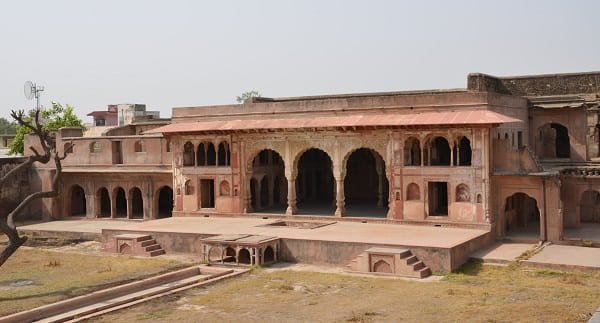
- Sheesh Mahal (Glass Palace) — Faujdar Khan’s double-storey residential palace built around 1733 in red sandstone, Mughal bricks, and Jhajjar stone, famous for its mirror-inlay work and Diwan-e-Aam water channel.
- Baoli Ghaus Ali Shah (Gol Baoli) — a remarkable 3-storey octagonal stepwell with stone staircases, restored by ASI; once connected to Sheesh Mahal via a tunnel.
- Jama Masjid — also built by Faujdar Khan, now repurposed as a Hindu temple-cum-Sikh gurudwara, featuring red sandstone slabs with Arabic inscriptions dating to Sultan Ghiyas-ud-din Balban (1200–1287).
- Sethani Ki Chhatri — a two-storeyed cenotaph on the Jhajjar Road dating to 1861 AD.
- Dilli Darwaza, Patli Darwaza, Jhajjari Darwaza — three surviving gateways of the original five.
- Sultanpur National Park — within Farrukhnagar tehsil on the Gurgaon Road, a major haunt for migratory birds during winter months.
- Pataudi Palace — around 12 km away, the historic palace of the Pataudi royal family.
- Jhajjar town — adjoining heritage town across the district border.
- Damdama Lake, Manesar, Sohna — popular weekend destinations within easy reach of Gurgaon.
Lifestyle and Real Estate in Farrukh Nagar Haryana
Farrukh Nagar carries a distinctly small-town Haryanvi character with a layered Mughal legacy — narrow lanes inside the old fort area lined with crumbling havelis, busy local markets along the main bazaar, and a population that retains strong agricultural and traditional roots even as urbanisation creeps in from Gurgaon. Haryanvi is the primary language, with Hindi serving as the official medium for administration. Socio-cultural life revolves around Hindu traditions, festivals like Diwali and Holi, agrarian rituals, and folk practices such as wrestling (kushti). Real estate has seen a dramatic transformation since the 1990s, with land prices rising steeply thanks to rapid urbanisation in Gurugram — reportedly an acre of farmland in Farrukhnagar fetched nearly ₹1 crore (about $250,000) by December 2007, and prices have appreciated significantly since then. The town is increasingly seen as an emerging investment corridor for plotted developments, farmhouses, and mid-segment housing projects, supported by the KMP Expressway and proximity to the Manesar industrial belt.
Final Thoughts on Farrukh Nagar Haryana
Farrukh Nagar (122506) is one of Haryana’s most fascinating heritage towns — a former Mughal salt-trading capital whose Sheesh Mahal, Baoli, and octagonal fort layout offer a glimpse into 18th-century India, even as 21st-century Gurugram pushes its borders ever closer. For history enthusiasts, weekend travellers from Delhi-NCR, and long-term real estate investors betting on Gurugram’s western expansion, Farrukh Nagar consistently delivers.
 Prateema Jain